Com'è pianificare un viaggio e viaggiare per le persone con disabilità
Le barriere che possono incontrare le persone con disabilità pianificando un viaggio.
Introduction
This Privacy Notice aims to clearly and transparently explain which personal data we collect when you visit our website, why we collect it, how we use it, and what Your rights are.
We process your personal data in accordance with Regulation (EU) 2016/679 (GDPR) and applicable national data protection laws. We are committed to ensuring that all processing activities are carried out in accordance with the principles of lawfulness, fairness, transparency, data minimization, integrity, and confidentiality.
Specifically, in this notice you will find information about:
-
which data we collect about you and for what purposes;
-
the legal bases on which we process such data;
-
who we may share your data with;
-
how long we retain your data;
-
your rights and how to exercise them.
While we sometimes need Your data for example, to respond to your requests or improve our website), we do so with respect, care and only when truly necessary.
Our Privacy Promises
-
We deeply value your privacy, and for this reason, we guarantee that:
-
We treat your data as if it were our own.
-
We use your data only for the purposes outlined in this notice.
-
We retain your data only for as long as strictly necessary.
-
We do not share your data with third parties without a valid legal basis or your explicit consent.
1. Who Processes Your Personal Data
The Data Controller — that is, the entity that determines the purposes and means of the processing of Your personal data — is AccessiWay S.a.S., with registered office at 7 Rue du Général Henrion Bertier, 92200 Neuilly-sur-Sein registered with the Nanterre Trade and Companies Register under number 914 022 595.
AccessiWay is part of the team.blue group and, in certain cases, acts as joint controller together with team.blue NV, with registered office at Skaldenstraat 121, 9042 Ghent, Belgium. In this context, Your personal data may be shared within the group for statistical, administrative, operational, and service improvement purposes.
AccessiWay and team.blue have defined their respective roles and responsibilities under a joint controllership agreement pursuant to Article 26 of the GDPR, ensuring full compliance with data protection regulations.
For more information regarding joint controllership or to exercise Your rights, you may contact AccessiWay via email at the following email addresses:
📧 legal.fr@accessiway.com or info@accessiway.com.
2. Who This Privacy Notice Applies To
This notice applies to:
-
users who browse the website www.accessiway.com,
-
individuals who contact us through the form available on the website or via email;
-
users who interact with tools we have implemented (e.g. widgets, cookies);
-
individuals who, through the website or other channels, access external platforms or third-party entities through which they may submit a job application (e.g. recruiting portals or employment agencies).
-
In such cases, the privacy notices of the third parties involved — independent from AccessiWay — also apply.
3. What Data We Process
To manage your interaction with our website, we may process the following categories of personal data:
-
Identification and contact details such as name, surname, company, job title, email address, and phone number.
-
These data may be partially processed through our customer relationship management (CRM) system.
-
Data relating to your interaction with our services such as information collected via the website or through Hubspot, such as communication history, preferences, requests, and commercial or technical notes.
-
Technical data such as IP address, device type, operating system, browser, access times, and other data automatically recorded by our systems or servers.
-
Browsing data and preferences such as collected via cookies or similar technologies, in accordance with the choices expressed through the cookie consent banner.
-
Application data such as personal information included in your CV or other documents submitted through third-party platforms (e.g. professional experience, education, contact details).
-
These data are processed by AccessiWay only after being transmitted by the third party, which remains autonomous in the initial processing.
4. Purposes and Legal Basis of Processing
We process Your personal data in compliance with Regulation (EU) 2016/679 (GDPR) and applicable national data protection laws. Your data may be processed for the following purposes:
-
Technical operation of the website
We process technical data, using technical cookies and similar tools, to allow You to access the site, view it correctly, and ensure it functions properly (e.g. browsing, content loading, storing preferences).
📌Legal basis: this processing is necessary to provide a service requested by the user, pursuant to Article 6(1)(b) of the GDPR. Your consent is not required for these cookies.
-
Handling contact or support requests
When you send us a request — via the contact form or by email — we process your data to respond and provide the information requested.
📌 Legal basis: this processing is necessary to take steps at your request prior to entering into a contract, pursuant to Article 6(1)(b) of the GDPR.
-
Compliance with legal obligations
In certain cases, we may need to process your data to comply with legal obligations, such as tax, accounting, or IT security requirements.
📌 Legal basis: this processing is based on compliance with a legal obligation, pursuant to Article 6(1)(c) of the GDPR.
-
Statistical analysis and website improvement
We use analytical tools (e.g. analytical cookies) to collect aggregated data in order to understand how the website is used and to improve its content and functionality.
📌 Legal basis: we process this data only with your freely given and specific consent, pursuant to Article 6(1)(a) of the GDPR.
-
Marketing and Profiling
If you authorize us to do so, we may use your data to send you promotional communications or provide personalized content (e.g. through profiling cookies).
📌 Legal basis: this processing is carried out only with your explicit consent, pursuant to Article 6(1)(a) of the GDPR. You may withdraw your consent at any time without affecting the lawfulness of processing based on consent before its withdrawal.
-
Management of job applications through third parties
We may receive job applications via third-party platforms (e.g. job portals) or through recruitment agencies. In such cases, we process the submitted data to assess your suitability for the proposed role.
📌 Legal basis: this processing is necessary to take steps at your request prior to entering into a contract, pursuant to Article 6(1)(b) of the GDPR.
Note: the privacy policies of the third-party platforms or agencies involved also apply, independently of AccessiWay.
5. Cookies and Tracking Tools
This website uses a cookie management system provided by iubenda, which allows you to:
-
view a full and transparent list of the cookies in use;
-
modify or withdraw your consent at any time;
-
access the complete Cookie Policy, integrated in the cookie widget.
You can manage your preferences by clicking on the cookie widget icon located at the bottom left corner of every page on the site.
Technical cookies are necessary and therefore enabled by default. Other non-essential cookies (analytical, profiling) are only enabled with your consent.
For more information, please refer to the full Cookie Policy accessible from the cookie widget.
6. Use of accessWidget
This website integrates accessWidget, an automated accessibility tool developed by accessiBe Ltd. and distributed by AccessiWay. The widget allows users to personalize their browsing experience based on their needs.
When the user activates the widget, their IP address is technically transmitted, but:
-
it is not stored, tracked, or associated with identifiable individuals;
-
it is anonymized via a proxy located in the European Union;
-
it is not used for profiling or marketing purposes.
📌 Legal basis: provision of a service requested by the user (Article 6(1)(b) of the GDPR).
7. Data Security
We adopt appropriate technical and organizational measures to ensure the security, integrity, and confidentiality of the personal data we process. These measures are designed to prevent unauthorized access, loss, disclosure, or alteration of your data. In particular, we implement:
-
secure connections via HTTPS (SSL/TLS);
-
authentication systems and access control;
-
access limitation and internal access tracking mechanisms;
-
regular audits and verification procedures;
-
continuous updates to systems and security measures according to the level of risk.
8. Data Retention
Your personal data is stored only for the time strictly necessary to achieve the purposes for which it was collected. Specifically:
-
Contact data: up to 10 years if relevant for contractual or legal purposes;
-
Technical and browsing data: according to what is outlined in the Cookie Policy;
-
Marketing data: until consent is withdrawn.
9. Your Rights (Data Subject Rights)
As a data subject, you may exercise the rights provided under Articles 15–22 of the GDPR at any time. In particular, you have the right to:
-
Obtain confirmation as to whether or not your personal data is being processed and access such data (right of access);
-
Request the rectification of inaccurate personal data or the completion of incomplete data (right to rectification);
-
Request the erasure of your data, if the conditions set out in the GDPR are met (right to erasure);
-
Obtain restriction of processing where applicable (right to restriction);
-
Object to the processing of your data, in whole or in part, under certain circumstances (right to object);
-
Receive your data in a structured, commonly used, and machine-readable format, and, where technically feasible, have it transmitted directly to another controller (right to data portability);
-
Withdraw your consent at any time, without affecting the lawfulness of processing based on consent before its withdrawal.
📧 You can exercise Your rights at any time by contacting us at: legal.fr@accessiway.com.
🔗 If you are located in France and believe that the processing of your personal data violates applicable law, you have the right to lodge a complaint with the French Data Protection Authority (Commission Nationale de l’Informatique et des Libertés – CNIL) via the website: www.cnil.fr.
*If you have difficulty accessing our form, please feel free to contact us. Send an e-mail to info@accessiway.com
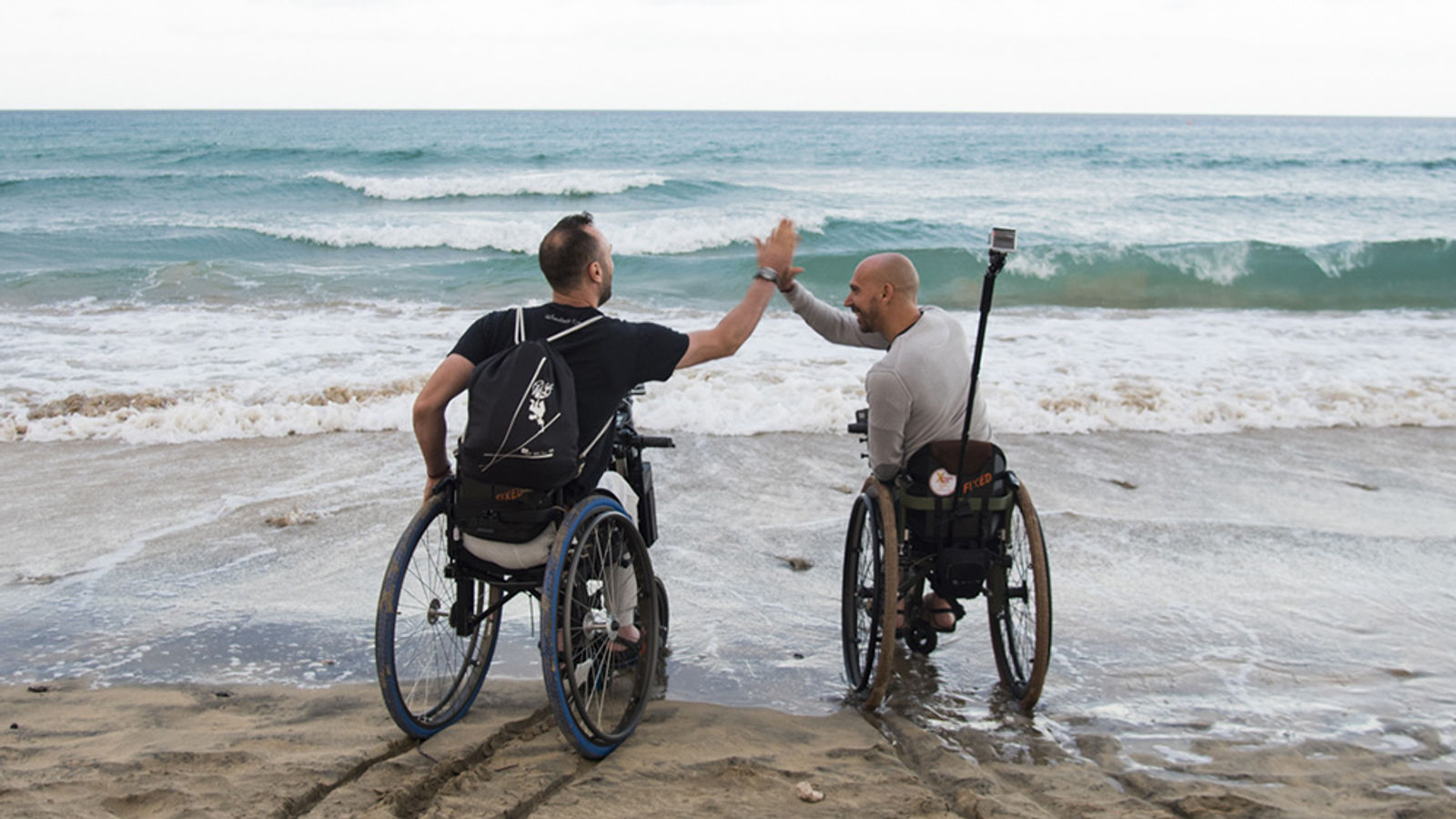
Le vacanze: attese, desiderate, per molte persone unico momento per staccare davvero il cervello e concedersi un po' di relax. La vacanza è anche il motivo per coronare un sogno: visitare il luogo sempre desiderato, facendo assumere alla vacanza il valore del viaggio, incrociando così la nostra storia a quella di altre culture, modi di vivere e alle volte ambienti mai visti. Questo vale, ovviamente, anche per coloro che vivono in una condizione di disabilità.
Per molti, il processo di pianificazione di una vacanza inizia online. Siti web e app dovrebbero essere, perciò, progettati seguendo i principi di accessibilità web, in modo tale da consentire a tutti, indipendentemente dalle loro possibilità, di navigare, comprendere e interagire facilmente. Tuttavia, le persone con disabilità che utilizzano tecnologie assistive molte volte incontrano serie problematiche. Le persone con disabilità visiva si scontrano molto spesso con la mancanza di compatibilità dei canali digitali con i lettori di schermo utilizzati o con l'assenza di testo alternativo per le immagini. Anche coloro che hanno disabilità motorie possono trovare difficoltà con siti web o applicazioni che non sono navigabili tramite tastiera o che richiedono azioni complesse per compiere semplici operazioni. Per non parlare delle guide in PDF, quelle da scaricare e quelle interattive! Le descrizioni delle strutture ricettive, dei trasporti e delle attività dovrebbero essere dettagliate e comprendere informazioni specifiche sull'accessibilità, come la presenza di rampe, ascensori, servizi igienici accessibili, e altro ancora. Purtroppo, quando i documenti non sono accessibili, queste informazioni sono spesso vaghe o completamente assenti, rendendo difficile per le persone con disabilità fisiche pianificare adeguatamente il loro viaggio.
Le piattaforme di prenotazione online spesso non offrono opzioni facilmente accessibili per richiedere assistenza o servizi speciali, e i sistemi di chat automatizzati non sono in grado di gestire richieste complesse. Questo, ancor più, può essere un problema significativo per le persone con disabilità uditive o di comunicazione, che potrebbero avere difficoltà a comunicare tramite telefono.
Per quanto riguarda il viaggio, inoltre, molti aspetti dipendono dalla tecnologia, inclusi i check-in elettronici, le mappe digitali e le app per la traduzione. Le persone con disabilità visive o motorie possono trovare queste tecnologie difficili da usare se non progettate pensando all'accessibilità. Ad esempio, le interfacce touch screen possono essere problematiche, sia per l’utilizzo fisico che per l’interazione visiva. Una volta arrivati a destinazione, poi, l'accesso a informazioni resta cruciale. Ciò include mappe e guide in formato leggibile da lettori di schermo, audio guide per i musei, e cartellonistica in Braille e con caratteri grandi. La mancanza di queste risorse può limitare significativamente l'autonomia e l'esperienza di viaggio di una persona con disabilità.
La navigazione nei siti dei sistemi di trasporto pubblico e l'accesso alle attrazioni possono presentare ulteriori sfide, specialmente se le informazioni in tempo reale non sono presentate in un formato accessibile. Le persone con disabilità visive, ad esempio, potrebbero avere difficoltà a identificare la fermata del bus corretta senza annunci vocali o informazioni in Braille, fondamentale ad esempio per l'orientamento all'interno delle stazioni. Migliorare l'accessibilità digitale nei servizi di viaggio non è, quindi, solo una questione di conformità legale, ma un passo essenziale verso l'inclusione di tutti i viaggiatori.
È fondamentale che gli sviluppatori di siti web, app e tecnologie digitali lavorino a stretto contatto con le persone con disabilità per comprendere le loro esigenze e implementare soluzioni efficaci. Allo stesso tempo, le compagnie di viaggio, gli albergatori e gli operatori turistici devono essere consapevoli dell'importanza di fornire informazioni dettagliate e accurate sull'accessibilità, garantendo che tutti possano godere appieno delle loro vacanze.
A tutela dei viaggiatori e viaggiatrici con disabilità è stata promulgata la Norma UNI PDR 131, che consentirà a strutture ricettive, aziende di trasporti e tutti coloro che lavorano in ambito turistico di far validare il loro grado di accessibilità, proprio attraverso questa certificazione. E' un passo importante perchè dà un riconoscimento reale per gli sforzi di acessibilità di chi lavora in questo settore e rappresenta, ancor di più, una forma di tutela per i viaggiatori con esigenze specifiche.

Paolo Berro
Sfatiamo insieme i miti sull'accessibilità digitale.
Accessibilita Digitale

Paolo Berro
Lo stato dell'accessibilità dell’e-commerce dei ticket
Accessibilita Digitale

Author
Forse dobbiamo iniziare a pensare fuori dagli schemi.
Accessibilita Digitale