UK-listed brands exposed to EU’s accessibility crackdown
Analysis of FTSE 100 consumer-facing websites finds widespread barriers affecting everyday digital journeys, from shopping and banking to travel and insurance

Introduction
This Privacy Notice aims to clearly and transparently explain which personal data we collect when you visit our website, why we collect it, how we use it, and what Your rights are.
We process your personal data in accordance with Regulation (EU) 2016/679 (GDPR) and applicable national data protection laws. We are committed to ensuring that all processing activities are carried out in accordance with the principles of lawfulness, fairness, transparency, data minimization, integrity, and confidentiality.
Specifically, in this notice you will find information about:
-
which data we collect about you and for what purposes;
-
the legal bases on which we process such data;
-
who we may share your data with;
-
how long we retain your data;
-
your rights and how to exercise them.
While we sometimes need Your data for example, to respond to your requests or improve our website), we do so with respect, care and only when truly necessary.
Our Privacy Promises
-
We deeply value your privacy, and for this reason, we guarantee that:
-
We treat your data as if it were our own.
-
We use your data only for the purposes outlined in this notice.
-
We retain your data only for as long as strictly necessary.
-
We do not share your data with third parties without a valid legal basis or your explicit consent.
1. Who Processes Your Personal Data
The Data Controller — that is, the entity that determines the purposes and means of the processing of Your personal data — is AccessiWay S.a.S., with registered office at 7 Rue du Général Henrion Bertier, 92200 Neuilly-sur-Sein registered with the Nanterre Trade and Companies Register under number 914 022 595.
AccessiWay is part of the team.blue group and, in certain cases, acts as joint controller together with team.blue NV, with registered office at Skaldenstraat 121, 9042 Ghent, Belgium. In this context, Your personal data may be shared within the group for statistical, administrative, operational, and service improvement purposes.
AccessiWay and team.blue have defined their respective roles and responsibilities under a joint controllership agreement pursuant to Article 26 of the GDPR, ensuring full compliance with data protection regulations.
For more information regarding joint controllership or to exercise Your rights, you may contact AccessiWay via email at the following email addresses:
📧 legal.fr@accessiway.com or info@accessiway.com.
2. Who This Privacy Notice Applies To
This notice applies to:
-
users who browse the website www.accessiway.com,
-
individuals who contact us through the form available on the website or via email;
-
users who interact with tools we have implemented (e.g. widgets, cookies);
-
individuals who, through the website or other channels, access external platforms or third-party entities through which they may submit a job application (e.g. recruiting portals or employment agencies).
-
In such cases, the privacy notices of the third parties involved — independent from AccessiWay — also apply.
3. What Data We Process
To manage your interaction with our website, we may process the following categories of personal data:
-
Identification and contact details such as name, surname, company, job title, email address, and phone number.
-
These data may be partially processed through our customer relationship management (CRM) system.
-
Data relating to your interaction with our services such as information collected via the website or through Hubspot, such as communication history, preferences, requests, and commercial or technical notes.
-
Technical data such as IP address, device type, operating system, browser, access times, and other data automatically recorded by our systems or servers.
-
Browsing data and preferences such as collected via cookies or similar technologies, in accordance with the choices expressed through the cookie consent banner.
-
Application data such as personal information included in your CV or other documents submitted through third-party platforms (e.g. professional experience, education, contact details).
-
These data are processed by AccessiWay only after being transmitted by the third party, which remains autonomous in the initial processing.
4. Purposes and Legal Basis of Processing
We process Your personal data in compliance with Regulation (EU) 2016/679 (GDPR) and applicable national data protection laws. Your data may be processed for the following purposes:
-
Technical operation of the website
We process technical data, using technical cookies and similar tools, to allow You to access the site, view it correctly, and ensure it functions properly (e.g. browsing, content loading, storing preferences).
📌Legal basis: this processing is necessary to provide a service requested by the user, pursuant to Article 6(1)(b) of the GDPR. Your consent is not required for these cookies.
-
Handling contact or support requests
When you send us a request — via the contact form or by email — we process your data to respond and provide the information requested.
📌 Legal basis: this processing is necessary to take steps at your request prior to entering into a contract, pursuant to Article 6(1)(b) of the GDPR.
-
Compliance with legal obligations
In certain cases, we may need to process your data to comply with legal obligations, such as tax, accounting, or IT security requirements.
📌 Legal basis: this processing is based on compliance with a legal obligation, pursuant to Article 6(1)(c) of the GDPR.
-
Statistical analysis and website improvement
We use analytical tools (e.g. analytical cookies) to collect aggregated data in order to understand how the website is used and to improve its content and functionality.
📌 Legal basis: we process this data only with your freely given and specific consent, pursuant to Article 6(1)(a) of the GDPR.
-
Marketing and Profiling
If you authorize us to do so, we may use your data to send you promotional communications or provide personalized content (e.g. through profiling cookies).
📌 Legal basis: this processing is carried out only with your explicit consent, pursuant to Article 6(1)(a) of the GDPR. You may withdraw your consent at any time without affecting the lawfulness of processing based on consent before its withdrawal.
-
Management of job applications through third parties
We may receive job applications via third-party platforms (e.g. job portals) or through recruitment agencies. In such cases, we process the submitted data to assess your suitability for the proposed role.
📌 Legal basis: this processing is necessary to take steps at your request prior to entering into a contract, pursuant to Article 6(1)(b) of the GDPR.
Note: the privacy policies of the third-party platforms or agencies involved also apply, independently of AccessiWay.
5. Cookies and Tracking Tools
This website uses a cookie management system provided by iubenda, which allows you to:
-
view a full and transparent list of the cookies in use;
-
modify or withdraw your consent at any time;
-
access the complete Cookie Policy, integrated in the cookie widget.
You can manage your preferences by clicking on the cookie widget icon located at the bottom left corner of every page on the site.
Technical cookies are necessary and therefore enabled by default. Other non-essential cookies (analytical, profiling) are only enabled with your consent.
For more information, please refer to the full Cookie Policy accessible from the cookie widget.
6. Use of accessWidget
This website integrates accessWidget, an automated accessibility tool developed by accessiBe Ltd. and distributed by AccessiWay. The widget allows users to personalize their browsing experience based on their needs.
When the user activates the widget, their IP address is technically transmitted, but:
-
it is not stored, tracked, or associated with identifiable individuals;
-
it is anonymized via a proxy located in the European Union;
-
it is not used for profiling or marketing purposes.
📌 Legal basis: provision of a service requested by the user (Article 6(1)(b) of the GDPR).
7. Data Security
We adopt appropriate technical and organizational measures to ensure the security, integrity, and confidentiality of the personal data we process. These measures are designed to prevent unauthorized access, loss, disclosure, or alteration of your data. In particular, we implement:
-
secure connections via HTTPS (SSL/TLS);
-
authentication systems and access control;
-
access limitation and internal access tracking mechanisms;
-
regular audits and verification procedures;
-
continuous updates to systems and security measures according to the level of risk.
8. Data Retention
Your personal data is stored only for the time strictly necessary to achieve the purposes for which it was collected. Specifically:
-
Contact data: up to 10 years if relevant for contractual or legal purposes;
-
Technical and browsing data: according to what is outlined in the Cookie Policy;
-
Marketing data: until consent is withdrawn.
9. Your Rights (Data Subject Rights)
As a data subject, you may exercise the rights provided under Articles 15–22 of the GDPR at any time. In particular, you have the right to:
-
Obtain confirmation as to whether or not your personal data is being processed and access such data (right of access);
-
Request the rectification of inaccurate personal data or the completion of incomplete data (right to rectification);
-
Request the erasure of your data, if the conditions set out in the GDPR are met (right to erasure);
-
Obtain restriction of processing where applicable (right to restriction);
-
Object to the processing of your data, in whole or in part, under certain circumstances (right to object);
-
Receive your data in a structured, commonly used, and machine-readable format, and, where technically feasible, have it transmitted directly to another controller (right to data portability);
-
Withdraw your consent at any time, without affecting the lawfulness of processing based on consent before its withdrawal.
📧 You can exercise Your rights at any time by contacting us at: legal.fr@accessiway.com.
🔗 If you are located in France and believe that the processing of your personal data violates applicable law, you have the right to lodge a complaint with the French Data Protection Authority (Commission Nationale de l’Informatique et des Libertés – CNIL) via the website: www.cnil.fr.
*If you have difficulty accessing our form, please feel free to contact us. Send an e-mail to info@accessiway.com
Analysis of FTSE 100 consumer-facing websites finds widespread barriers affecting everyday digital journeys, from shopping and banking to travel and insurance
London, 17 June 2026 Major UK-listed brands may be exposed to penalties under EU accessibility regulations, with a new analysis finding widespread digital barriers across the websites of FTSE 100 companies active in Europe.
The research by Accessiway, Europe’s leading digital accessibility provider, reviewed the websites of 24 UK-listed companies across sectors including retail, banking, insurance, telecoms, travel and ecommerce. Every website analysed showed at least one accessibility issue against the criteria tested.
The findings come as enforcement of the European Accessibility Act (EAA), which began applying on 28 June 2025, appears to be gathering pace. Earlier this month a French court ordered a major retailer to make its online shopping website and app fully accessible to people with visual impairments within six months, with fines of €500 per day if it fails to comply by the deadline.
While the UK is not directly covered by the EAA, the regulation - like GDPR - applies based on the markets a company serves rather than where it's headquartered. This means many UK-listed companies with European customers fall within its scope, while UK regulations such as the Equality Act 2010 also cover digital accessibility. Post-Brexit, the EU remains the UK’s largest trading partner, with UK exports of goods and services to the bloc worth £384 billion in 2025.
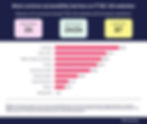
The most common issue identified in the UK sample was text resizing, with 20 of the 24 websites analysed showing problems when users enlarged text. A further 16 showed colour contrast issues, while 14 showed reflow problems, where content does not adapt properly to smaller screens, zoomed views or different browser settings.
These barriers can affect people with visual impairments, older users, customers with disabilities, neurodivergent users and anyone who relies on adjusting text size, using a keyboard, navigating on mobile, or adapting a website to suit their needs.
Jacopo Deyla, Chief Accessibility Officer at Accessiway, said:
“Most people resize text at some point, whether because of ageing eyesight or simply to make something easier to read on a phone. When that breaks a page, it affects everyone. But people with disabilities, including those with common visual impairments, are hit hardest and may be locked out of essential everyday activities altogether.”
Basic barriers still appearing across major consumer journeys
Accessiway reviewed 107 websites from listed companies across Austria, France, Germany, Italy and the UK. The analysis looked at selected accessibility criteria based on the Web Content Accessibility Guidelines (WCAG), including colour contrast, text resizing, reflow, keyboard navigation, focus visibility, skip links and focus order.
The UK findings are part of a wider pattern among listed companies across the five countries analysed. The same basic barriers appear repeatedly: text that cannot be resized properly, poor colour contrast and pages that break when viewed on smaller screens or enlarged settings. Text resizing was the most common issue in both the UK and France, affecting 20 of 24 UK sites and 19 of 21 French sites. In Italy and Austria, colour contrast was the leading problem, found on 21 of 25 Italian sites and 14 of 18 Austrian sites. Reflow was the most consistent issue overall, affecting at least half of the companies reviewed in every market.
Jacopo Deyla added: “Many of the most common accessibility issues are well understood and relatively easy to identify. The root problem is not that they are impossible to fix, but that accessibility still lacks clear ownership inside many organisations, and is not yet consistently embedded into how digital services are developed and maintained. Every redesign, campaign page, product update or checkout change has the potential to create new barriers unless accessibility is part of the process from the start.”
Automated scores can create false confidence
The research also highlights the limitations of relying too heavily on automated testing alone. Several websites performed strongly in automated accessibility tools, while manual checks still identified barriers that could affect users in practice.
Jacopo Deyla said: “Automated testing is useful, but it only tells part of the story. A strong dashboard score does not automatically mean a website is accessible in real life. Some of the most important barriers involve how a page behaves when a person uses a keyboard, enlarges text, changes display settings or navigates with assistive technology. Human testing, preferably with people with disabilities, is the only way to reliably identify these issues.”
Ends
Notes to Editor:
About the research
Accessiway reviewed 107 consumer-facing websites from major companies listed across five European stock-market indices: the FTSE 100, DAX, CAC 40, FTSE MIB and ATX Prime.
For the UK element of the analysis, Accessiway reviewed 24 consumer-facing websites from FTSE 100 companies with European operations. The research was conducted against selected accessibility criteria based on the Web Content Accessibility Guidelines, including contrast, text resizing, reflow, keyboard access, skip links, focus visibility, focus order, flashes and pause.
The findings represent a snapshot at the time the research was conducted. They do not constitute a full legal compliance audit or formal conformity assessment, but provide an indication of common accessibility barriers appearing across publicly available consumer-facing digital services.
About Accessiway
Accessiway is Europe’s fastest-growing digital accessibility company, committed to making the internet truly inclusive for people with disabilities. Founded in 2021, Accessiway combines automation with human expertise to help organisations meet international standards such as WCAG 2.2 and the European Accessibility Act (EAA). With a team of over 140 specialists supporting more than 2,000 clients across Italy, France, Austria, Germany and the UK, Accessiway works with organisations in e-commerce, finance, public services, education, and technology. In 2024, Accessiway joined team.blue, one of Europe’s leading digital services providers, accelerating its reach, product innovation and compliance impact across the continent.
More information: www.accessiway.com
Press Contacts
Melanie Defries: melanie.defries@accessiway.com
Tel: 07931 551213
.jpg)
Editorial Board
Article 50 of the AI Act applies from August 2, 2026. Those who operate chatbots, generate synthetic content, or publish deepfakes must inform individuals. Paragraph 5 adds a condition missing from almost all compliance checklists: the notice itself must comply with applicable accessibility requirements.
News
Editorial Board
That gap between what you're accountable for and what you can actually see is where risk lives. A digital accessibility platform closes it: not with another audit, but with a governance capability your team operates every day.
News

Author
The ruling against Carrefour shows that digital accessibility can no longer stay confined to an isolated technical team. It involves the legal department, the product department, and the executive team.
News