Come accedere alla carta disabilità sul portale INPS
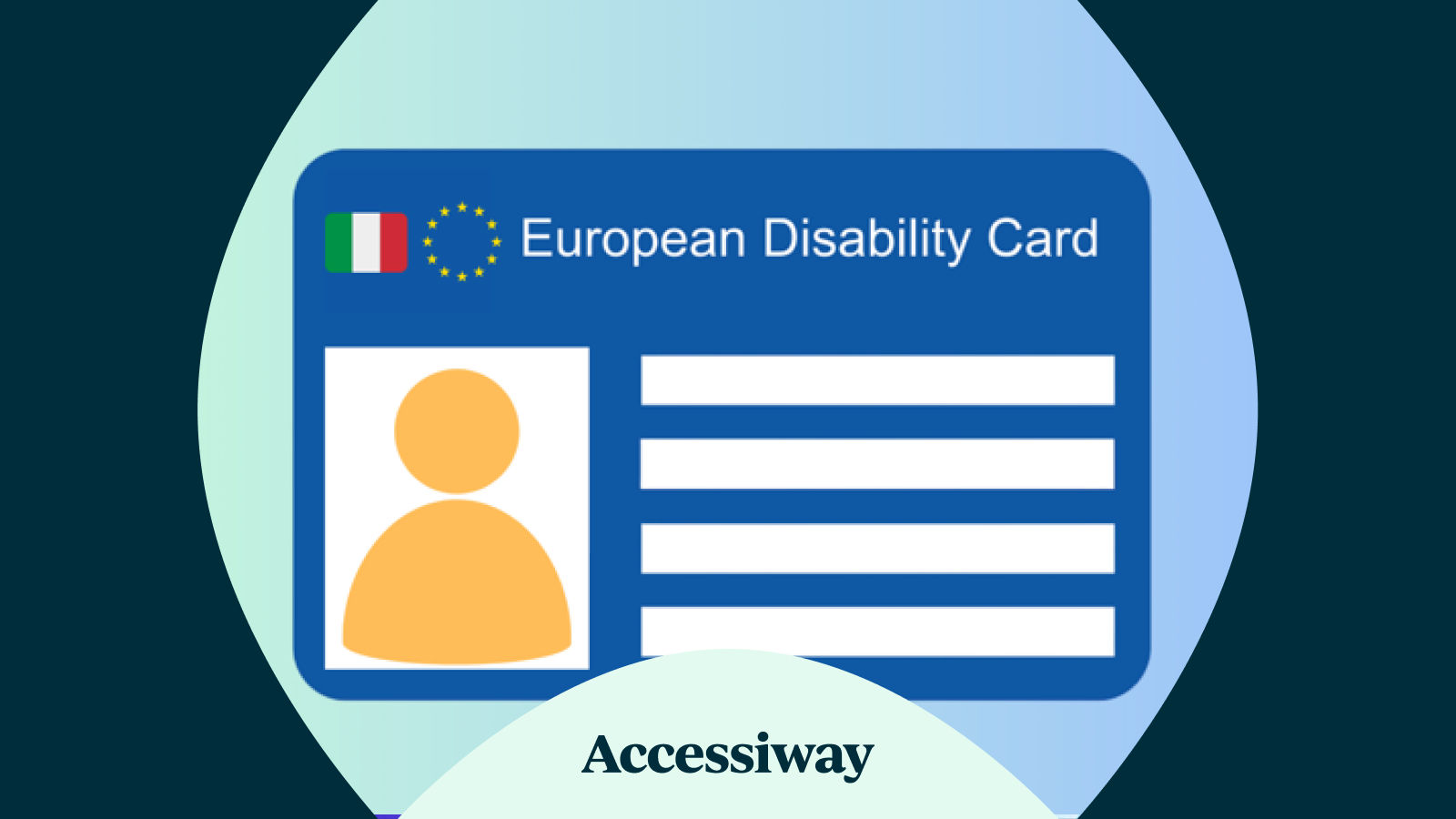
Dover cercare un verbale mentre si è in fila alla biglietteria di un museo porta la storia sanitaria dentro un momento che si voleva dedicare alla cultura. La Carta europea della disabilità, o Disability Card, può alleggerire questo passaggio.
Introduction
This Privacy Notice aims to clearly and transparently explain which personal data we collect when you visit our website, why we collect it, how we use it, and what Your rights are.
We process your personal data in accordance with Regulation (EU) 2016/679 (GDPR) and applicable national data protection laws. We are committed to ensuring that all processing activities are carried out in accordance with the principles of lawfulness, fairness, transparency, data minimization, integrity, and confidentiality.
Specifically, in this notice you will find information about:
-
which data we collect about you and for what purposes;
-
the legal bases on which we process such data;
-
who we may share your data with;
-
how long we retain your data;
-
your rights and how to exercise them.
While we sometimes need Your data for example, to respond to your requests or improve our website), we do so with respect, care and only when truly necessary.
Our Privacy Promises
-
We deeply value your privacy, and for this reason, we guarantee that:
-
We treat your data as if it were our own.
-
We use your data only for the purposes outlined in this notice.
-
We retain your data only for as long as strictly necessary.
-
We do not share your data with third parties without a valid legal basis or your explicit consent.
1. Who Processes Your Personal Data
The Data Controller — that is, the entity that determines the purposes and means of the processing of Your personal data — is AccessiWay S.a.S., with registered office at 7 Rue du Général Henrion Bertier, 92200 Neuilly-sur-Sein registered with the Nanterre Trade and Companies Register under number 914 022 595.
AccessiWay is part of the team.blue group and, in certain cases, acts as joint controller together with team.blue NV, with registered office at Skaldenstraat 121, 9042 Ghent, Belgium. In this context, Your personal data may be shared within the group for statistical, administrative, operational, and service improvement purposes.
AccessiWay and team.blue have defined their respective roles and responsibilities under a joint controllership agreement pursuant to Article 26 of the GDPR, ensuring full compliance with data protection regulations.
For more information regarding joint controllership or to exercise Your rights, you may contact AccessiWay via email at the following email addresses:
📧 legal.fr@accessiway.com or info@accessiway.com.
2. Who This Privacy Notice Applies To
This notice applies to:
-
users who browse the website www.accessiway.com,
-
individuals who contact us through the form available on the website or via email;
-
users who interact with tools we have implemented (e.g. widgets, cookies);
-
individuals who, through the website or other channels, access external platforms or third-party entities through which they may submit a job application (e.g. recruiting portals or employment agencies).
-
In such cases, the privacy notices of the third parties involved — independent from AccessiWay — also apply.
3. What Data We Process
To manage your interaction with our website, we may process the following categories of personal data:
-
Identification and contact details such as name, surname, company, job title, email address, and phone number.
-
These data may be partially processed through our customer relationship management (CRM) system.
-
Data relating to your interaction with our services such as information collected via the website or through Hubspot, such as communication history, preferences, requests, and commercial or technical notes.
-
Technical data such as IP address, device type, operating system, browser, access times, and other data automatically recorded by our systems or servers.
-
Browsing data and preferences such as collected via cookies or similar technologies, in accordance with the choices expressed through the cookie consent banner.
-
Application data such as personal information included in your CV or other documents submitted through third-party platforms (e.g. professional experience, education, contact details).
-
These data are processed by AccessiWay only after being transmitted by the third party, which remains autonomous in the initial processing.
4. Purposes and Legal Basis of Processing
We process Your personal data in compliance with Regulation (EU) 2016/679 (GDPR) and applicable national data protection laws. Your data may be processed for the following purposes:
-
Technical operation of the website
We process technical data, using technical cookies and similar tools, to allow You to access the site, view it correctly, and ensure it functions properly (e.g. browsing, content loading, storing preferences).
📌Legal basis: this processing is necessary to provide a service requested by the user, pursuant to Article 6(1)(b) of the GDPR. Your consent is not required for these cookies.
-
Handling contact or support requests
When you send us a request — via the contact form or by email — we process your data to respond and provide the information requested.
📌 Legal basis: this processing is necessary to take steps at your request prior to entering into a contract, pursuant to Article 6(1)(b) of the GDPR.
-
Compliance with legal obligations
In certain cases, we may need to process your data to comply with legal obligations, such as tax, accounting, or IT security requirements.
📌 Legal basis: this processing is based on compliance with a legal obligation, pursuant to Article 6(1)(c) of the GDPR.
-
Statistical analysis and website improvement
We use analytical tools (e.g. analytical cookies) to collect aggregated data in order to understand how the website is used and to improve its content and functionality.
📌 Legal basis: we process this data only with your freely given and specific consent, pursuant to Article 6(1)(a) of the GDPR.
-
Marketing and Profiling
If you authorize us to do so, we may use your data to send you promotional communications or provide personalized content (e.g. through profiling cookies).
📌 Legal basis: this processing is carried out only with your explicit consent, pursuant to Article 6(1)(a) of the GDPR. You may withdraw your consent at any time without affecting the lawfulness of processing based on consent before its withdrawal.
-
Management of job applications through third parties
We may receive job applications via third-party platforms (e.g. job portals) or through recruitment agencies. In such cases, we process the submitted data to assess your suitability for the proposed role.
📌 Legal basis: this processing is necessary to take steps at your request prior to entering into a contract, pursuant to Article 6(1)(b) of the GDPR.
Note: the privacy policies of the third-party platforms or agencies involved also apply, independently of AccessiWay.
5. Cookies and Tracking Tools
This website uses a cookie management system provided by iubenda, which allows you to:
-
view a full and transparent list of the cookies in use;
-
modify or withdraw your consent at any time;
-
access the complete Cookie Policy, integrated in the cookie widget.
You can manage your preferences by clicking on the cookie widget icon located at the bottom left corner of every page on the site.
Technical cookies are necessary and therefore enabled by default. Other non-essential cookies (analytical, profiling) are only enabled with your consent.
For more information, please refer to the full Cookie Policy accessible from the cookie widget.
6. Use of accessWidget
This website integrates accessWidget, an automated accessibility tool developed by accessiBe Ltd. and distributed by AccessiWay. The widget allows users to personalize their browsing experience based on their needs.
When the user activates the widget, their IP address is technically transmitted, but:
-
it is not stored, tracked, or associated with identifiable individuals;
-
it is anonymized via a proxy located in the European Union;
-
it is not used for profiling or marketing purposes.
📌 Legal basis: provision of a service requested by the user (Article 6(1)(b) of the GDPR).
7. Data Security
We adopt appropriate technical and organizational measures to ensure the security, integrity, and confidentiality of the personal data we process. These measures are designed to prevent unauthorized access, loss, disclosure, or alteration of your data. In particular, we implement:
-
secure connections via HTTPS (SSL/TLS);
-
authentication systems and access control;
-
access limitation and internal access tracking mechanisms;
-
regular audits and verification procedures;
-
continuous updates to systems and security measures according to the level of risk.
8. Data Retention
Your personal data is stored only for the time strictly necessary to achieve the purposes for which it was collected. Specifically:
-
Contact data: up to 10 years if relevant for contractual or legal purposes;
-
Technical and browsing data: according to what is outlined in the Cookie Policy;
-
Marketing data: until consent is withdrawn.
9. Your Rights (Data Subject Rights)
As a data subject, you may exercise the rights provided under Articles 15–22 of the GDPR at any time. In particular, you have the right to:
-
Obtain confirmation as to whether or not your personal data is being processed and access such data (right of access);
-
Request the rectification of inaccurate personal data or the completion of incomplete data (right to rectification);
-
Request the erasure of your data, if the conditions set out in the GDPR are met (right to erasure);
-
Obtain restriction of processing where applicable (right to restriction);
-
Object to the processing of your data, in whole or in part, under certain circumstances (right to object);
-
Receive your data in a structured, commonly used, and machine-readable format, and, where technically feasible, have it transmitted directly to another controller (right to data portability);
-
Withdraw your consent at any time, without affecting the lawfulness of processing based on consent before its withdrawal.
📧 You can exercise Your rights at any time by contacting us at: legal.fr@accessiway.com.
🔗 If you are located in France and believe that the processing of your personal data violates applicable law, you have the right to lodge a complaint with the French Data Protection Authority (Commission Nationale de l’Informatique et des Libertés – CNIL) via the website: www.cnil.fr.
*If you have difficulty accessing our form, please feel free to contact us. Send an e-mail to info@accessiway.com
Dover cercare un verbale mentre si è in fila alla biglietteria di un museo porta la storia sanitaria dentro un momento che si voleva dedicare alla cultura.
La Carta europea della disabilità, o Disability Card, può alleggerire questo passaggio: attesta la condizione di disabilità e permette di accedere alle agevolazioni previste dai soggetti convenzionati. Richiederla è gratuito e il punto di partenza è il portale INPS.
Chi può richiedere la Disability Card
Prima della domanda, conviene verificare i requisiti. Tra gli aventi diritto ci sono i maggiorenni con invalidità civile almeno del 67%, i minori con invalidità civile, chi percepisce l’indennità di accompagnamento, chi ha una certificazione ai sensi dell’articolo 3, comma 3, della legge 104, le persone cieche e sorde civili. Esistono anche altre categorie previdenziali e di invalidità sul lavoro: l’elenco completo è nella scheda INPS. La carta viene rilasciata su richiesta e l’Istituto controlla i requisiti nei propri archivi.
Come fare domanda sul portale INPS
Accesso al servizio
Per iniziare, si entra su inps.it e si cerca «Carta europea della disabilità – Disability Card». Nella scheda si seleziona «Utilizza il servizio», relativo alla richiesta della carta in Italia. L’accesso avviene con SPID di livello 2, Carta d’identità elettronica o Carta nazionale dei servizi: gli strumenti che permettono al sistema di riconoscere chi presenta la domanda.
Dati anagrafici, foto e recapito
La procedura mostra i dati anagrafici e l’indirizzo di residenza già disponibili. Occorre controllarli, caricare una fotografia a colori in formato tessera e indicare un diverso recapito, se necessario. Per la foto vanno seguite le specifiche del modulo.
Casi particolari e documenti da allegare
La verifica negli archivi evita di ricostruire tutta la documentazione, ma esistono casi particolari. L’INPS richiede di allegare i verbali cartacei anteriori al 2010 e quelli rilasciati dalla Valle d’Aosta o dalle Province autonome di Trento e Bolzano, dichiarandone la conformità all’originale. Se il riconoscimento deriva da una sentenza o da un decreto di omologa, bisogna indicare il Tribunale e la data del provvedimento. Preparare questi elementi prima di cominciare può risparmiare interruzioni.
Chi può aiutare nella richiesta
Chi incontra difficoltà può rivolgersi alle associazioni abilitate ANMIC, UICI, ENS e ANFFAS, che presentano la domanda con una delega specifica. Per i minori interviene chi esercita la responsabilità genitoriale o la tutela.
Tempi e consegna della carta
Dopo l’invio, è utile conservare la conferma della richiesta. La carta è prodotta dal Poligrafico e Zecca dello Stato e spedita da Poste Italiane al recapito indicato. L’INPS fissa in 60 giorni il termine di conclusione del procedimento, dalla domanda completa: non è una promessa di consegna in una data precisa.
Il codice QR e la tutela della riservatezza
La parte tecnologica più interessante è il codice QR. Quel piccolo quadrato rimanda alle informazioni aggiornate sulla condizione riconosciuta. Le FAQ del Ministro per le Disabilità distinguono due livelli: per le agevolazioni offerte dai privati, come l’accesso a un museo, è sufficiente la verifica di base. I dati più dettagliati richiedono invece un operatore qualificato e un codice temporaneo inviato via SMS al titolare. Conoscere questa distinzione aiuta a proteggere la riservatezza: per una riduzione sul biglietto non serve aprire le informazioni sanitarie di secondo livello. La carta va esibita insieme a un documento d’identità valido.
La versione digitale nell’app IO
C’è poi un’evoluzione concreta: dopo aver ottenuto la tessera fisica, si può aggiungere la sua versione digitale all’app IO. Si accede con SPID o CIE, si apre «Portafoglio», si preme «Aggiungi», si seleziona la Carta europea della disabilità e si seguono le istruzioni. La versione nell’app ha lo stesso valore legale della tessera in Italia. Una foto della carta o uno screenshot, invece, non hanno quel valore: è una differenza essenziale, soprattutto quando si cerca di semplificare la vita usando il telefono. L’attivazione è facoltativa e resta possibile utilizzare il documento fisico. È una scelta in più, da valutare secondo le proprie necessità.
Cosa garantisce la carta e cosa no
Per usarla bene, vale la pena consultare le convenzioni pubblicate sul sito del Ministro per le Disabilità e verificare le condizioni del servizio che interessa. La tessera non garantisce qualsiasi ingresso gratuito o sconto sui trasporti. Semplifica il riconoscimento del requisito, mentre il beneficio dipende dalle regole applicabili. Prima di partire per l’estero, bisogna controllare il riconoscimento nel Paese di destinazione e le singole agevolazioni.
L’accessibilità della procedura online
Resta un criterio con cui misurare questa innovazione: quanto è facile arrivare fino in fondo? Per chi usa un lettore di schermo, comandi vocali o la sola tastiera, contano pulsanti riconoscibili, istruzioni comprensibili e messaggi d’errore utili a correggersi. Sono obiettivi di accessibilità da perseguire dall’autenticazione al caricamento della foto. Una carta pensata per favorire la partecipazione dovrebbe poter essere richiesta con la stessa autonomia che vuole sostenere nella vita quotidiana.

Paolo Berro
Tra l'ingresso in azienda e l'accesso ai ruoli decisionali delle persone con disabilità continua a esistere uno spazio difficile da attraversare.
Inclusione E Csr
.jpg)
Paolo Berro
Essere un consulente del lavoro accessibile significa aiutare l'impresa a considerare la persona prima della categoria amministrativa e l'inclusione prima dell'emergenza.
Inclusione E Csr

Author
Mettere un touchscreen al posto di una matita non significa aver reso il voto accessibile. È da qui che dovrebbe partire ogni progetto di voto elettronico: da ciò che l’elettore riesce effettivamente a fare.
Inclusione E Csr